

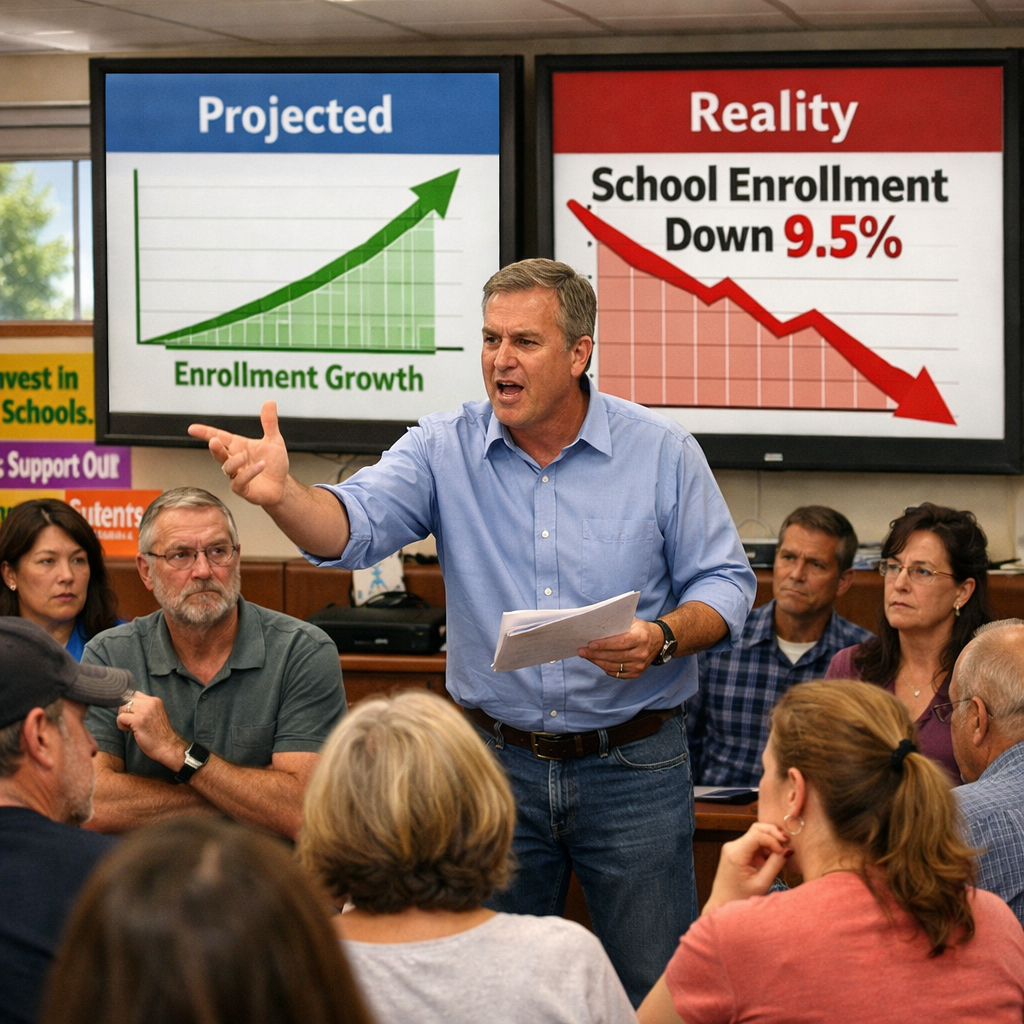
In June 2021, Bellingham Public Schools published its 2021-22 adopted budget book. In that book, the district projected 11,065 students for 2020-21 — a year that had already ended — and budgeted for 11,126 students for 2021-22, the year just starting.
When the actual numbers came in, the picture was different.
2020-21 actual enrollment: 10,795 — 270 students below the “projection” the district had published after the school year ended.
2021-22 October enrollment: 10,896 — 230 students below the budget book’s own assumption.
Eight months after publishing those projections, in February 2022, the district asked Bellingham voters to approve a $122 million capital bond — pitched on language about “projected growth in our district boundaries” and a new elementary school for “the northside of town where growth is occurring.”
The growth wasn’t there. The district had the numbers. Voters didn’t.
That gap — between what BSD published and what BSD knew — is the story.
What BSD knew at the time of the vote
By February 8, 2022, Bellingham Public Schools had three consecutive years of actual enrollment running below its own 2018-19 peak. The district had been collecting these numbers monthly. The 2020-21 school year was complete. The 2021-22 October count was on the books.
The trend visible to anyone reading BSD’s own enrollment reports:
| Year | Actual enrollment | vs. 2018-19 peak |
|---|---|---|
| 2018-19 (peak) | 11,108 | — |
| 2019-20 | 11,074 | −34 |
| 2020-21 | 10,795 | −313 |
| 2021-22 (in progress) | 10,896 | −212 |
The bond campaign called for growth. The data said the opposite.
What BSD told voters
The official 2022 bond materials emphasized facility age, condition, and “projected growth.” The district’s own bond page mentioned “growth in our district boundaries” and proposed a new 15th elementary school on King Mountain property “where growth is occurring.”
What was not in the bond materials: any acknowledgment of three years of declining enrollment, any disclosure that the growth projection the district was using had been overtaken by reality, or any explanation of why the August 2020 demographic study — which predicted 12,012 students by 2025-26 — was still being used to justify a bond two years later when actuals were already running 1,100 students below the projection’s trajectory.
The pamphlet didn’t lie. It just left out the numbers that would have answered the obvious question: do you actually need this capacity?
What BSD said when asked
The Bellingham School District has now publicly acknowledged that the bond plan didn’t survive contact with reality. The 15th elementary on King Mountain has been paused since 2024. The conversation about the Carl Cozier replacement was paused in March 2026. A district Facilities Planning Task Force is now evaluating elementary school closures.
When Cascadia Daily News asked the district in April 2026 about the gap between projections and actuals, a spokesperson said: “the updated data was a surprise to the district as well, given past growth estimates.”
This is the defense that doesn’t survive math.
The “updated data” wasn’t a surprise. The 2020-21 enrollment came in at 10,795 — a number BSD had counted, processed, and reported through the state. The 2021-22 October count came in at 10,896 — a number BSD certified to OSPI to receive state apportionment. Both of those figures were in BSD’s hands months before the bond went to the board, and at least 18 months before voters cast ballots. The district wasn’t “surprised” — it just didn’t update the projections it was using publicly.
What the $122M is paying for now
The 2022 bond is locked in for 20-plus years. The debt-service line shows up on every Bellingham property tax bill as the BSD #501 Bond Levy, regardless of whether the underlying buildings serve more students, fewer students, or end up consolidated.
The bond’s two primary stated uses were:
- A 15th elementary school on the King Mountain site (growth-driven)
- Design and partial replacement work for Carl Cozier, Columbia, and Roosevelt elementary schools (facility-age-driven)
The 15th elementary plan is now paused indefinitely. The Carl Cozier replacement is paused. Some of the bond money is still going toward facility work — but the package that voters approved isn’t the package that will get built.
Property owners pay either way. The bond doesn’t recalibrate to match what BSD ended up doing with the money.
The deeper story — and why the breakout appeared now
There’s a second piece of this that’s only become visible in the past year. BSD’s newer budget books have started breaking out Running Start enrollment as a separate line — a presentation change that makes the headline “Total” enrollment appear larger than older budgets would have shown.
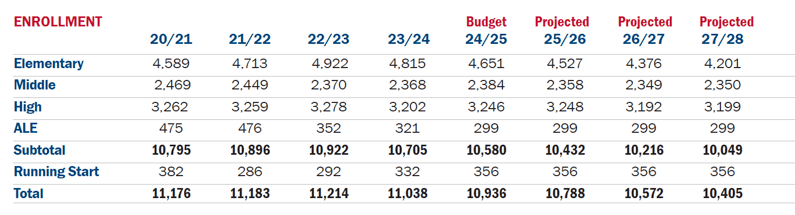 Running Start has existed in Washington since 1990. The way BSD presents it changed because the 2026 legislative session cut the state’s Running Start FTE cap from 1.40 to 1.30 — costing BSD an estimated piece of the $7.5 million operating deficit the district has now publicly acknowledged.
The breakout isn’t new methodology. It’s new visibility. The district now has to explain to taxpayers, in budget presentations, exactly how much of the headline “Total” is Running Start FTE — money that flows mostly to the participating college, not BSD. The full investigation walks through the math.
What this means for your tax bill
If you own property in Bellingham, the BSD #501 Bond Levy is one of about 20 lines that make up your annual property tax bill. The bond piece is locked in for the next 20+ years. The rate per $1,000 of assessed value adjusts year by year to make the debt service payment — but the dollar amount BSD owes the bondholders is fixed by the issuance schedule.
You can look up any Bellingham address and see exactly which levies hit the bill, how much each one has changed, and what the trend looks like:
Search your Bellingham property tax →
The bigger question
No one is arguing that no Bellingham school facility needs work. Some buildings genuinely need updates. Some neighborhoods have different needs than they did 20 years ago. Those merits are a separate conversation.
What’s not a separate conversation: a bond authorization campaign that emphasized growth — to fund growth-driven capacity — when the district’s own published projections had already been contradicted by its own enrollment counts for three years running, and the district chose not to update or disclose the gap.
That’s the hustle. Not a lie. A redirection. A campaign that focused voters on what the district wanted them to think about, while the district itself was already sitting on data showing a different reality.
Property owners are paying for that redirection for the next two decades.
Where the data lives
The full investigation, with the projection-vs-actuals exhibits, the year-by-year tables, the FTE-accounting walkthrough, and links to every source document:
realrecord.org/investigations/bellingham-schools-bond-vs-enrollment
Every BSD adopted budget book from 2014-15 through 2024-25 is archived in Real Record’s public-records library. The Washington Office of the Superintendent of Public Instruction’s enrollment files going back to 2014-15 are archived alongside. Any reporter or community member can verify the math.
Real Record holds the primary sources. We publish the math. The information is there for you to decide.
Real Record is a project of Real Housing Reform Initiative, a 501©(3) nonprofit. We publish primary-source fiscal data and analysis at the city, county, and district level across Washington State. We don’t take advertising. Tips welcome at brian@realhousingreform.org.
Sources used in this piece
- BSD 2021-22 adopted budget book — published June 2021; shows projected 11,065 for 2020-21 and 11,126 for 2021-22. Archived in Real Record’s BSD library.
- BSD 2024-25 adopted budget book — shows the same years’ actuals at 10,795 and 10,896.
- BSD 2022 Bond information page — official campaign materials at bellinghamschools.org/about/departments/finance/bond-2022. Includes the “projected growth in our district boundaries” framing.
- Cascadia Daily News, April 20, 2026: “Bellingham sought bond in 2022 to plan rebuilds of schools that now face closure. What changed?” — contains the August 2020 projection of 12,012 by 2025-26 and the spokesperson’s “surprise to the district as well” quote.
- Cascadia Daily News, February 22, 2026: “With enrollment declining, Bellingham Public Schools considers elementary closures.”
- Cascadia Daily News, April 1, 2026: “No elementary schools will close before 2027, Bellingham superintendent says.”
- OSPI Report Card Enrollment files for BSD #501 (DistrictCode 37501) 2014-15 through 2025-26 preliminary.
- Whatcom County Elections — February 8, 2022 special election results: BSD Proposition 1 ($122M bond) passed at 60.1%.
Comments