


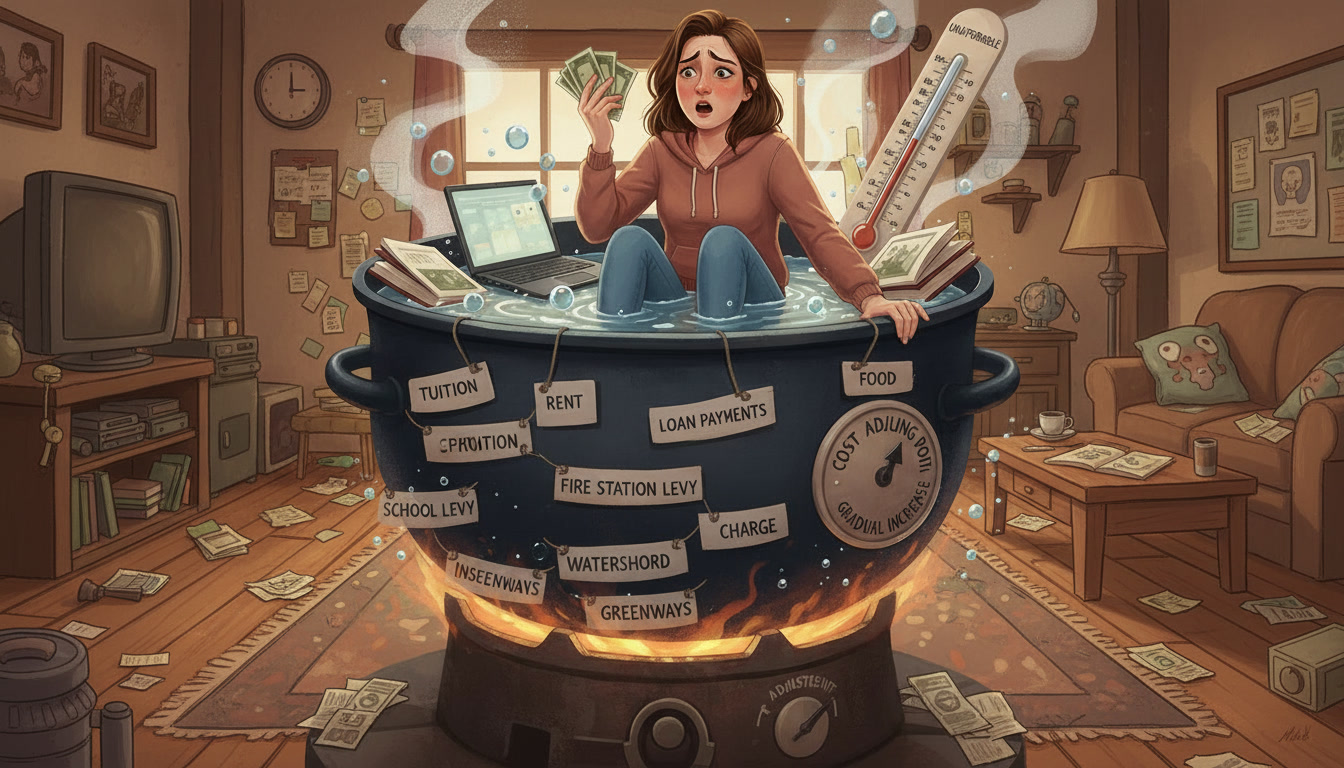
One of many reasons everything feels so expensive in Bellingham right now.
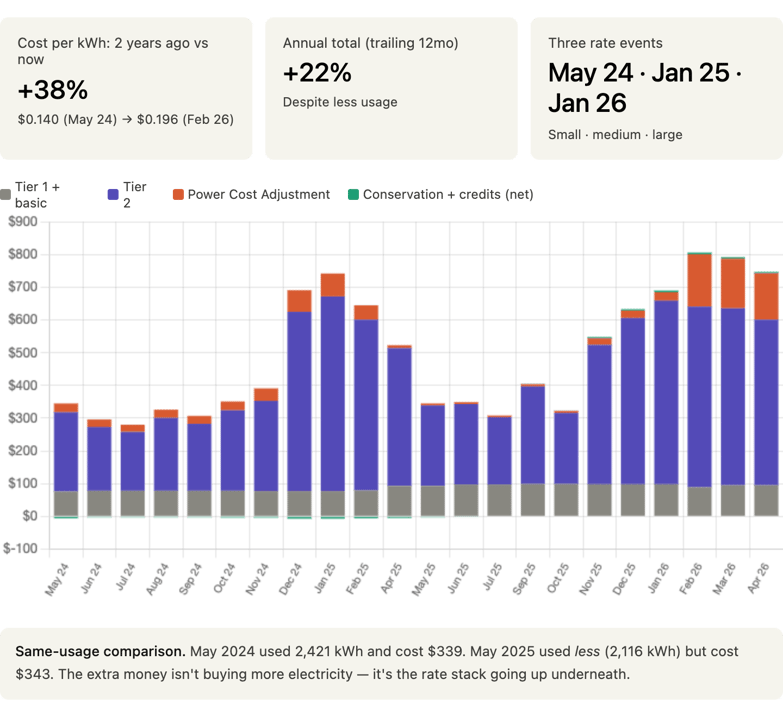 In May 2024, I used 2,421 kilowatt-hours of electricity at my house in Bellingham. My Puget Sound Energy bill was $338.69.
In May 2025, I used 2,116 kilowatt-hours — about three hundred fewer. My PSE bill was $342.55.
Same house. Same habits. Less electricity. More money.
That paradox is the whole story, and it's worth walking through slowly because it's not unique to me — it's quietly happening to every PSE household in Whatcom County — and because it's one clear, documented example of why Bellingham feels so much more expensive than it did even two years ago. I'm not here to tell you whether the politics behind this are right or wrong. I'm here to tell you that your bill isn't confused and you aren't imagining it.
What actually happened to my bill
I pulled every PSE statement I could find — two full years of them, May 2024 through April 2026. Then I broke each one apart into its components: the basic charge, the Tier 1 and Tier 2 energy rates, the Power Cost Adjustment, and the various conservation and credit lines.
Here's what the numbers show.
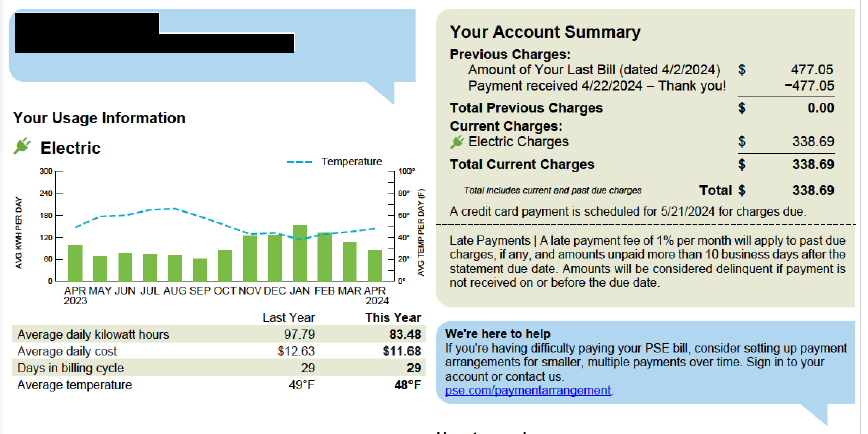
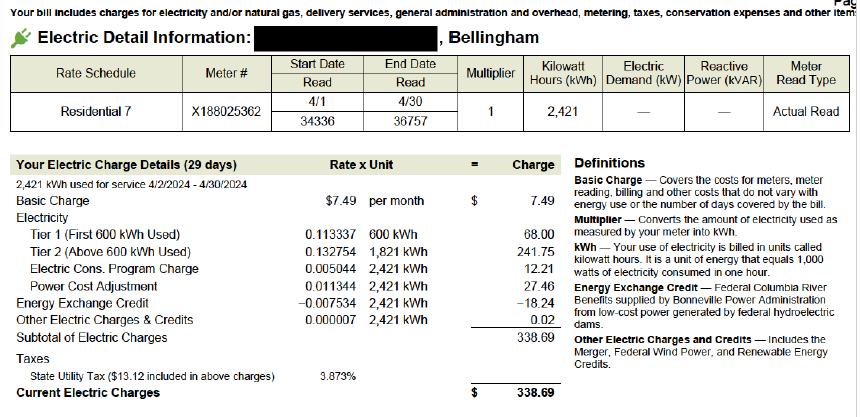 My usage from summer 2024 through summer 2025 was flat to slightly lower than the year before. My winter 2025-26 usage was 10 to 15 percent lower than winter 2024-25. I didn't do anything dramatic — it was probably a mild winter and a few small habits — but PSE prints last year's daily average right next to this year's on every bill, and the pattern is consistent. In December 2024 I averaged 141 kWh per day. In December 2025 it was 123. January 2025 was 151. January 2026 was 138.
And yet every winter bill this year was higher than the same month last year.
That is because there have been three separate rate changes since spring 2024, each one approved through a different regulatory docket:
- May 2024 — a small base-rate bump.
- January 2025 — tier rates jumped about 20 percent. At the same time, a line item called the Power Cost Adjustment was cut. Most bills came out roughly similar.
- January 2026 — tier rates held roughly flat. But the Power Cost Adjustment jumped from about $0.007 per kilowatt-hour to $0.039. That's roughly thirteen times higher.
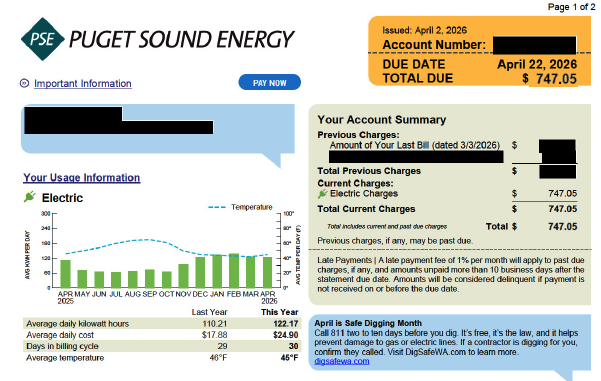
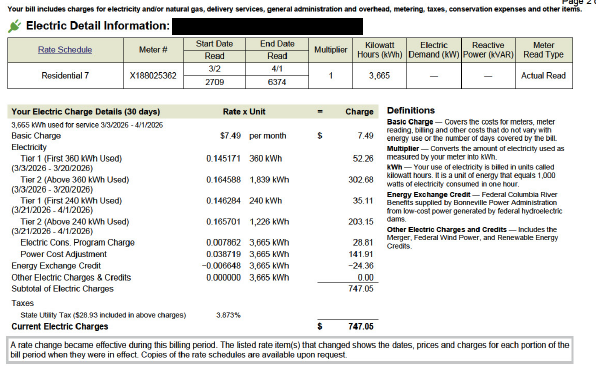 That last one is the big one. On a typical 3,600-kWh winter bill, the Power Cost Adjustment alone now adds about $130 compared to a year ago. It's the single biggest reason my bills look the way they do — and it's almost certainly the single biggest reason yours do, if you're on PSE.
Who approved this and why
Rate increases for PSE aren't secret, they aren't arbitrary, and they aren't technically unilateral. PSE files with the Washington Utilities and Transportation Commission. The UTC holds hearings. Commission staff review the numbers. Three commissioners vote. Sometimes they approve everything. Sometimes — like in March 2025 — they deny a follow-on request because they find the extra ask unreasonable.
The 2026 increase came out of a cluster of dockets approved December 23, 2025. PSE's stated reasons, directly from their filings and the UTC's press release:
- Climate Commitment Act (CCA) compliance — Washington's cap-and-trade program, which requires large emitters including utilities to buy allowances for their carbon emissions at state auction.
- Clean Energy Transformation Act (CETA) compliance — the state law requiring 100 percent carbon-neutral electricity by 2030 and 100 percent carbon-free by 2045. PSE has to retire its legacy coal generation (Colstrip) and natural gas plants, then replace that capacity with wind, solar, and battery storage projects. The new resources cost more per kilowatt-hour than what they're replacing.
- Infrastructure investment — wildfire hardening, grid modernization, Baker River hydro upgrades, and distribution work to accommodate EV charging and rooftop solar.
- Low-income bill assistance — funded through a charge on every other ratepayer's bill.
I'm not arguing whether any of those four things are good ideas. Some of them I support. But every one of them appears on my bill, folded into line items with opaque names, and the total is real money out of my actual checking account.
The UTC has also ordered PSE to start breaking the CCA portion out as a separate line item called "State Carbon Reduction Charge" by June 2026 — so in a few months we'll finally see explicitly how much of each bill is going to carbon compliance specifically.
Why this lands harder in Bellingham than Seattle
Two things make this worse for Whatcom County than for most of the Puget Sound region.
First: we're stuck on PSE. Puget Sound Energy is an investor-owned utility — meaning it has shareholders, and a guaranteed rate of return on the capital it invests, written into Washington regulation. Seattle City Light, Tacoma Power, and Snohomish County PUD are publicly owned. Public utilities don't have shareholders to pay. They also receive a larger share of the federal Bonneville Power Administration's cheap hydroelectric power. PSE customers pay meaningfully more per kilowatt-hour than Seattle City Light or Tacoma Power customers for the same product. We can't shop around. PSE's service territory is fixed by state regulation, and for almost all of Bellingham, PSE is the only option.
Second: our climate. We heat for eight months a year. A cold January here is a month where a 4,000-kWh bill isn't unusual. People in Tucson who are paying a lower per-kilowatt-hour rate are also using a fifth of the electricity. We take the hit on both sides — higher rates and higher usage, compounding each other.
There's more coming
PSE has already filed its next rate case — docket 260005 at the UTC — requesting a three-year plan. If approved, an average residential electric customer would see their bill rise another $28 per month in 2027, another $7 in 2028, and another $16 in 2029 — a cumulative $51 per month added to an average bill over three years. For households with winter bills already in the $700–$800 range, the real-dollar impact will be higher.
I'm writing this because I think most people see their bill, wince, and move on. The numbers make more sense once you lay them next to each other. They don't justify the outcome — they just explain it. My bills went up 22 percent over two years because the rate stack underneath them went up 22 percent. I used less electricity. I was rewarded with a bigger check to write.
If you want to push back on the next round, the UTC takes public comment on docket 260005 at utc.wa.gov. That's the lever available. Whether it moves anything, I don't know. But I'd rather push on it than pretend the bill is fine.
And if you're wondering why everything in Bellingham feels more expensive right now — groceries, gas, housing, childcare — this is one line item. Your landlord's electric bill at the building you rent went up the same way mine did. So did your grocery store's refrigeration bill. So did your daycare's heating bill. This stuff compounds, and it's showing up everywhere all at once, and it's not because people are bad at budgeting.
It's because the math underneath us changed.

Comments